A Tragedy of Errors, and an Accounting
After a crash, the Marines set an example
Peggy Noonan, Wall Street Journal, 6 Mar 2009
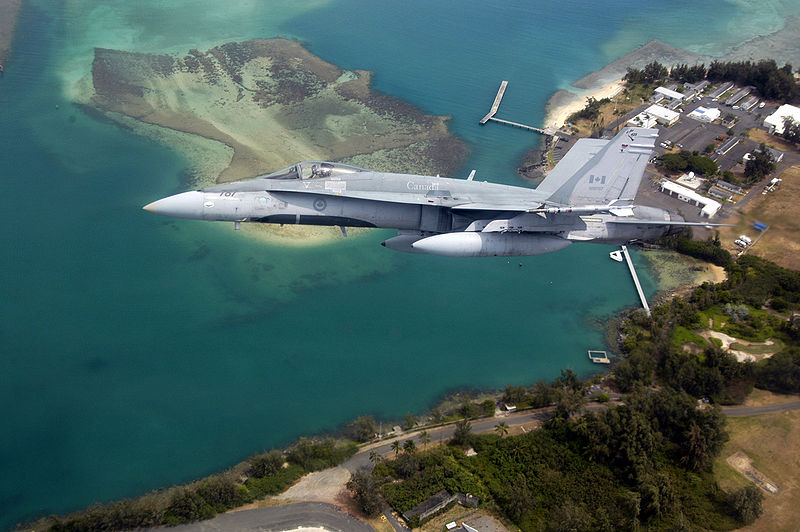 It is late in the morning one day last December.
A plane is in distress, it's lost one engine and now two and it's going down,
and people on the ground hear the sound, look up, say, "That's going awful
low," and whip out their cellphones. You could see the pictures they took later
on the news.
It sounds like Chesley Sullenburger and US Airways Flight 1549, but that was
five weeks later. This was the military jet that went down in San Diego; this
was the story that ended badly.
Then this week it took a turn. And looked at a certain way, the San Diego story
is every bit as big, and elements of it just as deserving of emulation, as
Sully saving all souls when he put down in the Hudson.
It's Dec. 8, 2008, 11:11 a.m., and a young Marine pilot takes off from an
aircraft carrier, the USS Abraham Lincoln, on a routine training flight. The
carrier is maybe 90 miles southwest of San Diego. Lt. Dan Neubauer is flying an
F/A-18 Hornet. Minutes into the flight, he notices low oil pressure in one of
the two engines. He shuts it down. Then the light shows low fuel for the other
engine. He's talking to air traffic control and given options and suggestions
on where to make an emergency landing. He can go to the naval air station at
North Island, the route to which takes him over San Diego Bay, or he can go to
the Marine air station at Miramar, with which he is more familiar, but which
takes him over heavily populated land. He goes for Miramar. The second engine
flames out. About three miles from the runway, the electrical system dies. Lt.
Neubauer tries to aim the jet toward a canyon, and ejects at what all seem to
agree is the last possible moment.
The jet crashed nose down in the University City neighborhood of San Diego,
hitting two homes and damaging three. Four people, all members of a Korean
immigrant family, were killed - 36-year-old Youngmi Lee; her daughters, Grace,
15 months, and Rachel, 2 months, and her 60-year-old mother, Seokim Kim.
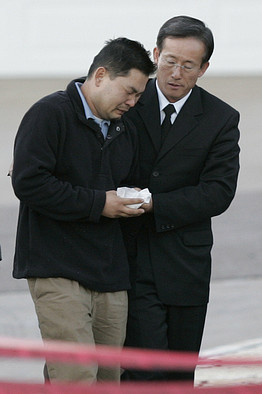 Lee's husband, a grocer named Dong Yun Yoon, was at work. The day after he'd
lost his family, he humbled and awed San Diego by publicly forgiving the pilot
– "I know he did everything he could" – and speaking of his faith
– "I know God
is taking care of my family."
Lee's husband, a grocer named Dong Yun Yoon, was at work. The day after he'd
lost his family, he humbled and awed San Diego by publicly forgiving the pilot
– "I know he did everything he could" – and speaking of his faith
– "I know God
is taking care of my family."
His grace and generosity were staggering, but there was growing local anger at
the military. Why was the disabled plane over land? The Marines launched an
investigation - of themselves. This Wednesday the results were announced. They
could not have been tougher, or more damning. The crash, said MajGen Randolph
Alles, the assistant wing commander for the Third Marine Aircraft Wing, was
"clearly avoidable," the result of "a chain of wrong decisions."
The report found that mechanics had noticed the aircraft had a faulty fuel
transfer system in June 2008 but repairs were never made, with the defective
jet performing 146 more sorties in this state before the December accident.
Neubauer failed to read his own emergency checklists, instead having sections
read to him by his squadron representatives on the ground. The squadron
representatives at Miramar were unaware of all the details of the situation on
board and did not read out all the relevant sections.
Upon final approach to Miramar, Neubauer thought, incorrectly, that he could
not turn right, towards his inoperative engine. Instead, he conducted a long
leftwards loop to line up. The maneuver took around 90 seconds to complete and
starved the left engine of fuel, causing it to flameout.
The report stated that a second or two delay in ejecting would have likely
resulted in the pilot's death. It is thought that if the aircraft had stayed
airborne 2 more seconds that would have been enough for the plane to reach the
canyon.
The fuel problem was not repaired in June because it was not on a list of
faults requiring immediate repair, but nonetheless 3rd Marine Aircraft Wing
operations officer Col. John Rupp said keeping it in the air "was collectively
poor judgment on the part of the squadron's maintenance department."
"While we did not find any evidence of criminal wrongdoing, the responsible
parties are being held accountable for their part in this tragic accident,"
said MajGen Alles.
The commanding officer, operations officer, aviation maintenance officer and
operations duty officer have all been relieved of duty (their military careers
are essentially over), while eight other Marines and a sailor were
reprimanded. The pilot is grounded while a board reviews his future.
The Marines issued a bulletin to all other operators of the aircraft worldwide
to warn them of the circumstances.
So far, the Marines and the U.S. Navy have identified 40 F/A-18 Hornets with
the same problem. None of these have crashed.
Residents told the San Diego Union-Tribune that they were taken aback by the
report. Bob Johnson, who lived behind the Yoons and barely escaped the crash,
said, "The Marines aren't trying to hide from it or duck it. They took it on
the chin." A retired Navy pilot who lives less than a block from the crash and
had formed, with neighbors, a group to push the Marines for an investigation,
and for limiting flights over University City, said after the briefing, "I
think we're out of business." In a later story the paper quoted a retired
general, Bob Butcher, chairman of a society of former Marine aviators, calling
the report "as open and frank a discussion of an accident as I've seen." "It
was a lot more candid than many people expected."
This wasn't damage control, it was taking honest responsibility. And as such,
in any modern American institution, it was stunning.
The day after the report I heard from a young Naval aviator in predeployment
training north of San Diego. He flies a Super Hornet, sister ship to the plane
that went down. He said the Marine investigation "kept me up last night"
because of how it contrasted with "the buck-passing we see" in the government
and on Wall Street. He and his squadron were in range of San Diego television
stations when they carried the report's conclusions live. He'd never seen "our
entire wardroom crowded around a television" before. They watched "with bated
breath." At the end they were impressed with the public nature of the
criticism, and its candor: "There are still elements within the government that
take personal responsibility seriously." He found himself wondering if the
Marines had been "too hard on themselves." "But they are, after all, Marines."
By contrast, he says, when the economy came crashing down, "nowhere did we see
a board come out and say: 'This is what happened, these are the decisions these
particular people made, and this was the result. They are no longer a part of
our organization.' There was no timeline of events or laymen's explanation of
how a credit derivative was actually derived. We did not see congressmen get on
television with charts and eviscerate their organization and say, 'These were
the men who in 2003 allowed Freddie and Fannie unlimited rein over mortgage
securities.' Instead we saw ... everybody against everybody else with no one
stepping forth and saying, 'We screwed up ...'" There is no one in national
leadership who could convincingly "assign blame," and no one "who could or
would accept it."
This of course is true, but somehow more stinging when said by a serviceman.

3 emails between Andy (former Marine CH-53 pilot) and Vince (former Marine F-4 navigator)
Date: 17 Mar 2009
From: Andy
Pretty sobering. Sad to see careers ruined but the Marines are at least
admitting that people should have done a better job. I'll bet everybody who
ever worked in squadron maintenance and operations would understand the
pressure to keep planes flying. No forgiveness when they find out you pushed
the limits to meet the op-ready percentage they expect. Thanks for the
information.
Date: 18 Mar 2009
From: Vince
I have been haunted by the story of this accident. Some of my angst was about
the pressures on maintenance departments that you raised. But most of my
"issues" relate to the pilot's dilemma. My father said that after he read the
email, his immediate reaction was - the pilot was in a no-win situation.
In perfect hindsight, the pilot should have gone to North Island, and failing
that, should have made the much shorter right turn at home field. But had he
done either of those and averted the crisis, he would then have become the
target of much derision.
If he had "wimped out" (i.e. been too cautious/alarmist) and gone to North
Island, he would have been "counseled" about making the squadron send a
maintenance crew on the road to fix the aircraft - OR - about making the
squadron exercise a dusty, fragile, and time-consuming inter-service,
inter-squadron maintenance request.
If he had turned into his dead engine, a NATOPS Nazi would have gigged him for
violating the recommendation: avoid turning into a dead engine. [I am assuming
there is "guidance" to that effect.]
Date: 19 Mar 2009
From: Vince
My father tells an interesting story about his C-130 check flight. In the
landing pattern he was on a left-hand base, when the check pilot pulled his 2
port engines back to idle and announced they had both failed. The correct
response was: roll wings level, level off, report the emergency to the tower
and request a right-hand 270 degree turn to an extended final. Any response
short of that would constitute failure.